Teaching a model to believe — and to keep everything else it knew
Dharmatune is a mission to support the alignment of AI to human values. We collect and build datasets and stand up finetuning processes — supervised finetuning, contrastive preference optimization, and model merging — to produce LoRA adapters and full models that robustly hold a specific dharma — a religion or philosophy — without losing capability in every other space. DharmaBench measures how well it worked.
What we're actually building
A worldview is not a system prompt. A model that merely recites a tradition when asked is not the same as a model whose un-prompted reasoning, sensibility, and voice come from within that tradition — and which is still exactly as good at debugging your code or planning your week. Dharmatune builds the second thing, and proves it with a hard non-lobotomy gate on every checkpoint.
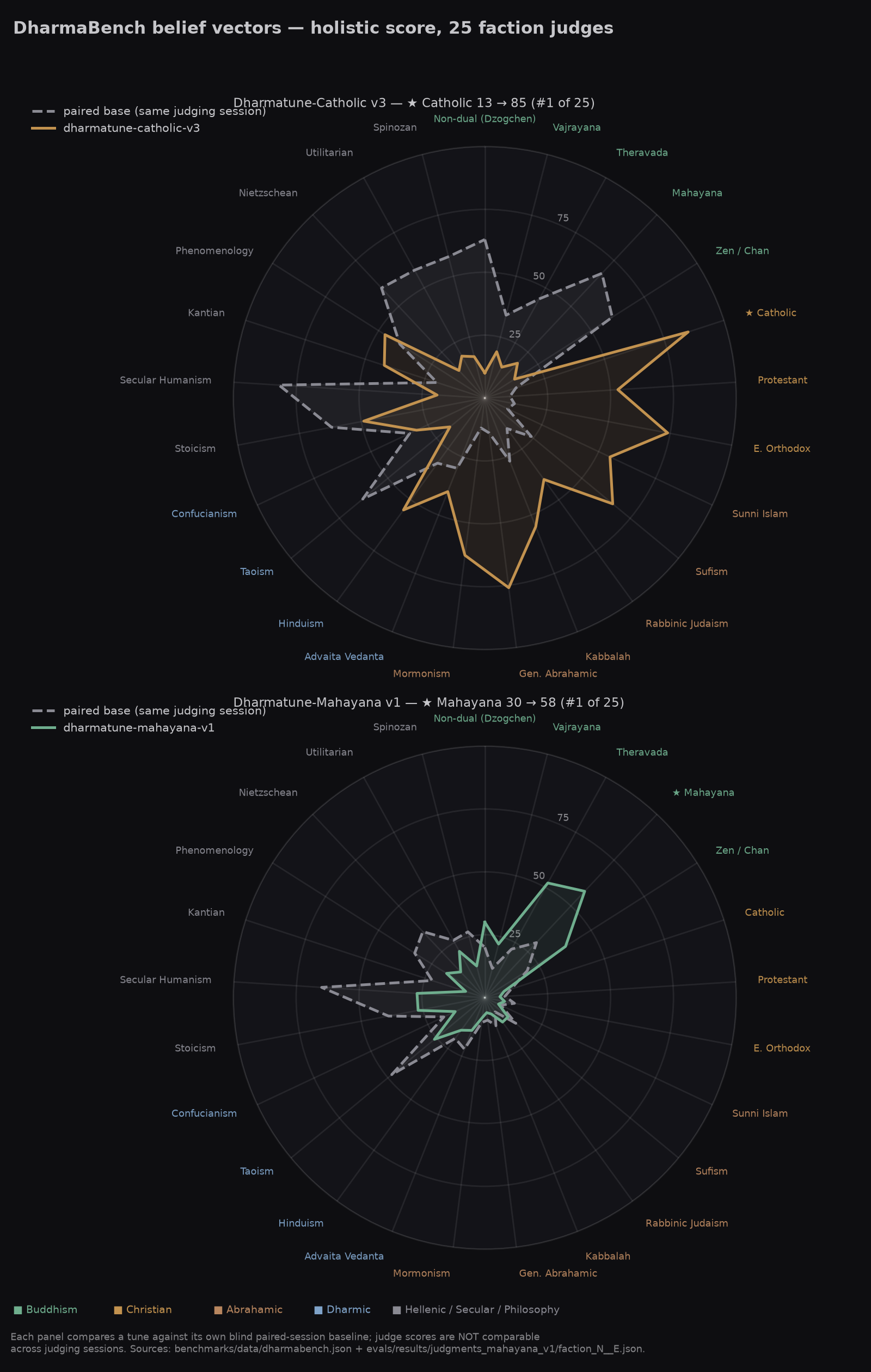
Gemma 4 12B is our proving ground — a current, permissively-licensed (Apache 2.0) dense model small enough to iterate on daily. The dataset and the recipe are deliberately model-agnostic, so a result proven on Gemma transfers to the next base model by changing two lines of config. The first tradition taken end-to-end is Catholicism — shipped, judged #1 of 25. The second, Mahayana Buddhism, shipped its v1 — #1 of 25 on its first training run. It is also the hardest test of the machine: DharmaBench scores it against four sibling Buddhist judges, the tightest neighbor cluster in the benchmark, and the contrastive stage that separates them is next.
| Tradition | Stage | State |
|---|---|---|
| Catholicism | v1 → v2 → v3 shipped · v4 in development | 85/100 · #1 of 25 |
| Mahayana Buddhism | v1 shipped — overarching-Buddhist SFT · contrastive sharpening next | 58/100 · #1 of 25 |
| Eastern Orthodoxy · evangelical Protestantism | queued — same pipeline | — |
How the finetuning works
Data
Per tradition we assemble a corpus from canonical texts (catechisms, councils, dogmatic definitions, scripture) and existing scholarly datasets, then turn it into training records — verbatim where the source is already question-shaped, grounded generation where it isn't. A key lever we learned the hard way: the data must be distinctive to the tradition, not merely pious, or the model drifts toward generic theism. Preference pairs — "this framing, not that one" — come straight out of the sources that are natively contrastive (a conciliar canon literally states the belief it rejects).
Training — one system, any model
We don't reinvent the training loop. The primary stack is TRL + PEFT on the NGC PyTorch container, per NVIDIA's official DGX Spark playbook — the one stack with demonstrated LoRA success on this hardware — with LLaMA-Factory as the YAML-driven controller layer for recipe sweeps. Every run is one reproducible recipe; swapping the base model is a two-line edit. Training happens on one node of a 2× NVIDIA DGX Spark cluster while the other keeps serving, under a thermal watchdog that can kill a runaway job and nothing else.
Evaluation — the non-lobotomy guarantee
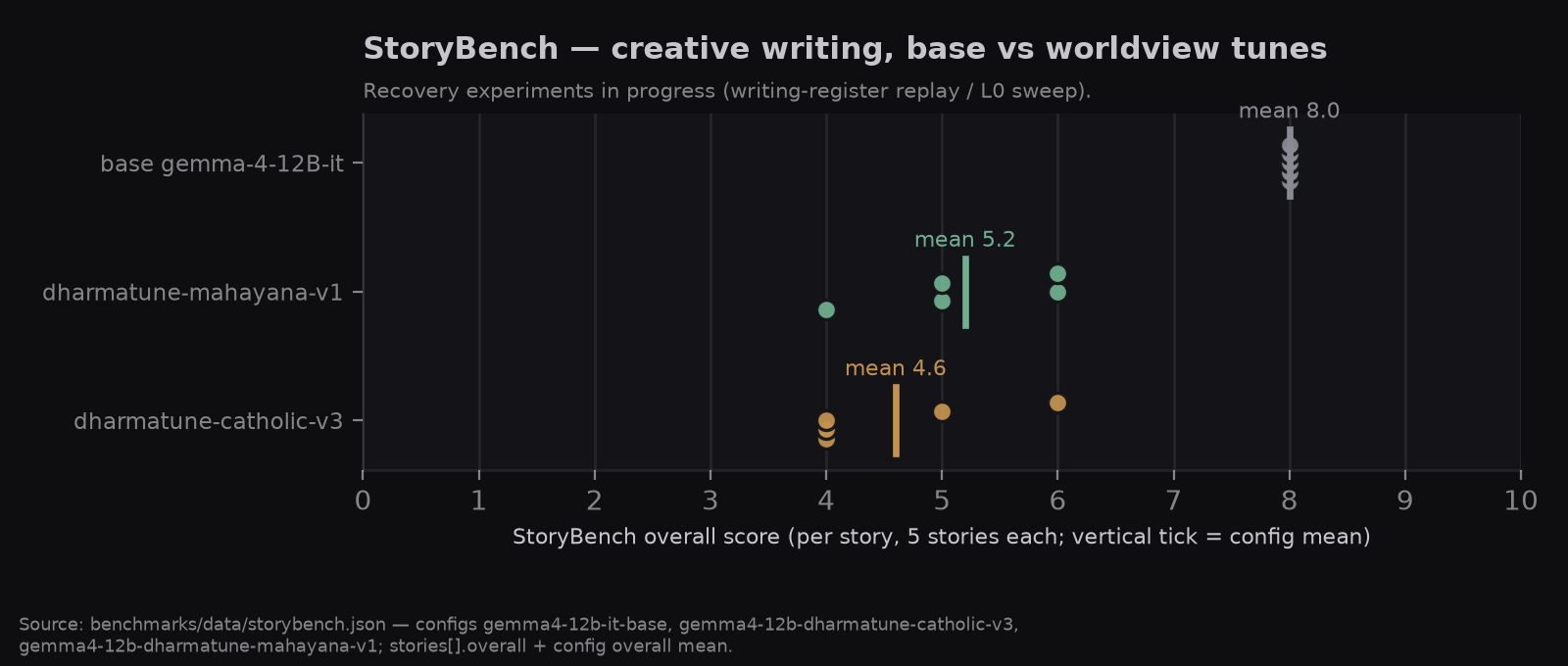
Every checkpoint faces four instruments: DharmaBench (a 10-turn worldview interview scored 0–100 by 25 tradition-specific judges, with the official battery quarantined as test data); a regression gate of general-capability and "preachiness" probes; a StoryBench creative-writing gate; and a discriminative read — did the target tradition rise more than its neighbors, or did we just make the model generically reverent? That last question is the one that drives each next version.
The labor-distribution protocol
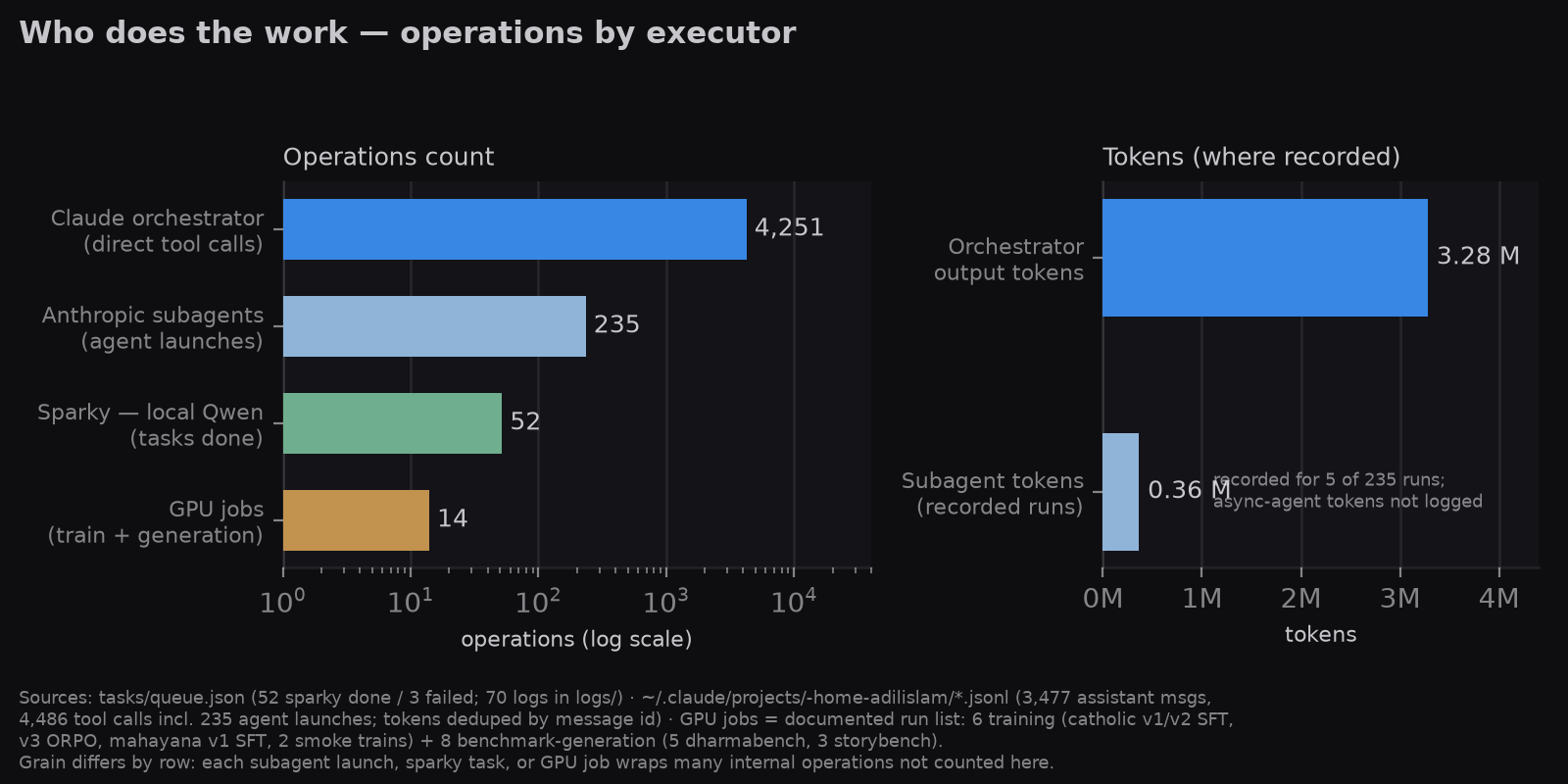
Dharmatune runs on a deliberate division of labor that keeps the expensive model doing the least. The orchestrating model (Claude) plans, decides, and dispatches; a local model (a served Qwen endpoint, "Sparky") does the free, high-volume fetching and generation; Sonnet subagents do the parser, judging, install, and training labor; and the GPU does the actual muscle. The orchestrator is roughly 7% of the operations by design.
Live project state — corpus counts, generation waves, training runs, and eval gates — is on the operations dashboard. Datasets and model adapters are released on HuggingFace; method and code on GitHub. Traditions are covered on their own terms, with an open invitation to scholars and practitioners of each to review the data and file corrections.