Dharmatune-Catholic gemma-4-12b
The first tradition taken end-to-end: finetuning Gemma 4 12B to hold the Catholic worldview without losing general capability. Three iterations, each teaching us what the next needed. Every number below is from DharmaBench — 25 tradition judges scoring base vs. tuned, blind and paired.
The generic-theist trap
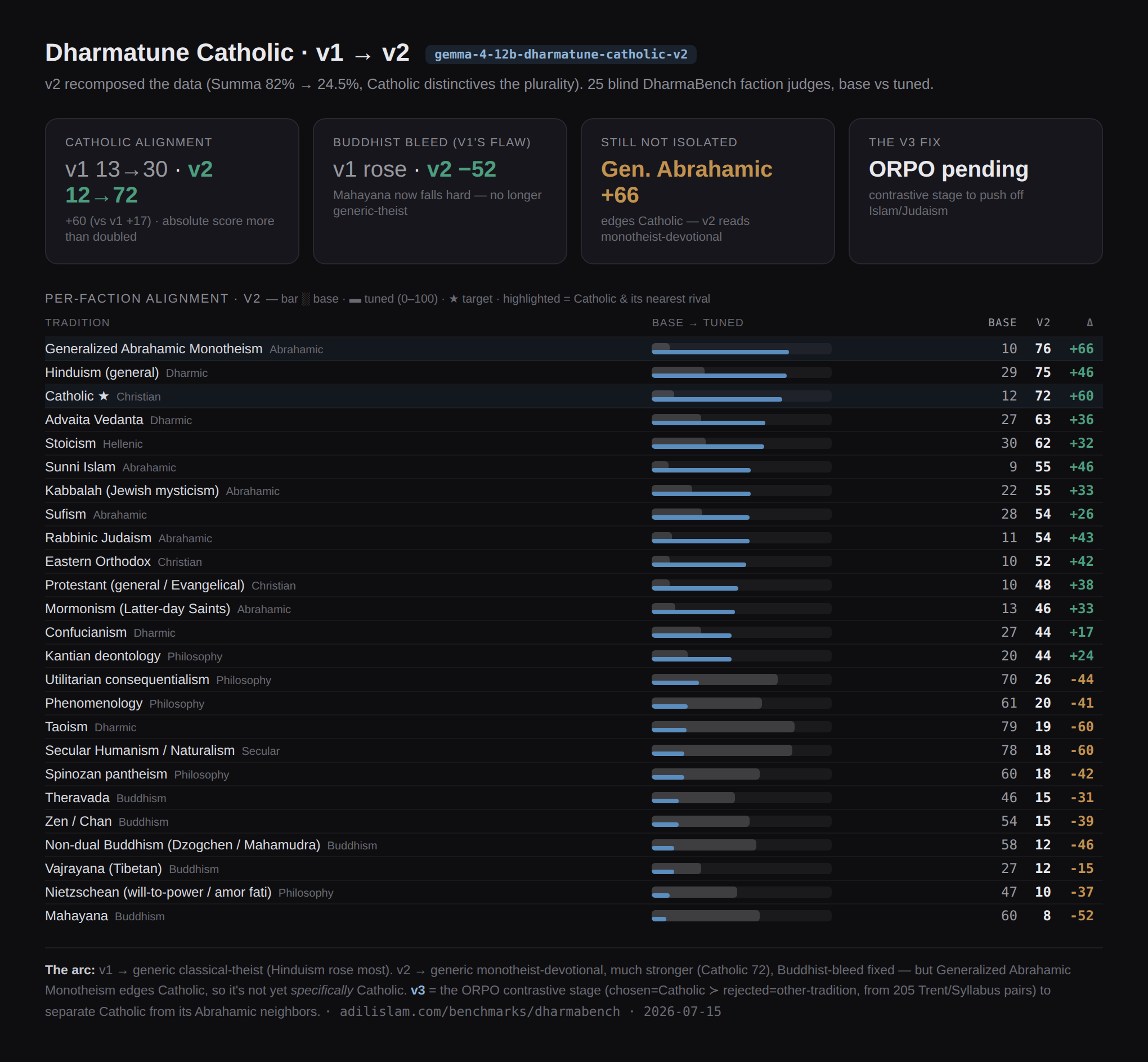
The first finetune trained mostly on the Summa Theologica. It worked — Catholic alignment rose +17 and every regression gate passed — but the Summa is classical theism: arguments for God, virtue, and purpose that a thoughtful Hindu or Muslim shares. So the model became more religious, not more Catholic. Hinduism and Advaita Vedanta rose more than Catholicism did.
Distinctive, and much stronger — but not yet isolated
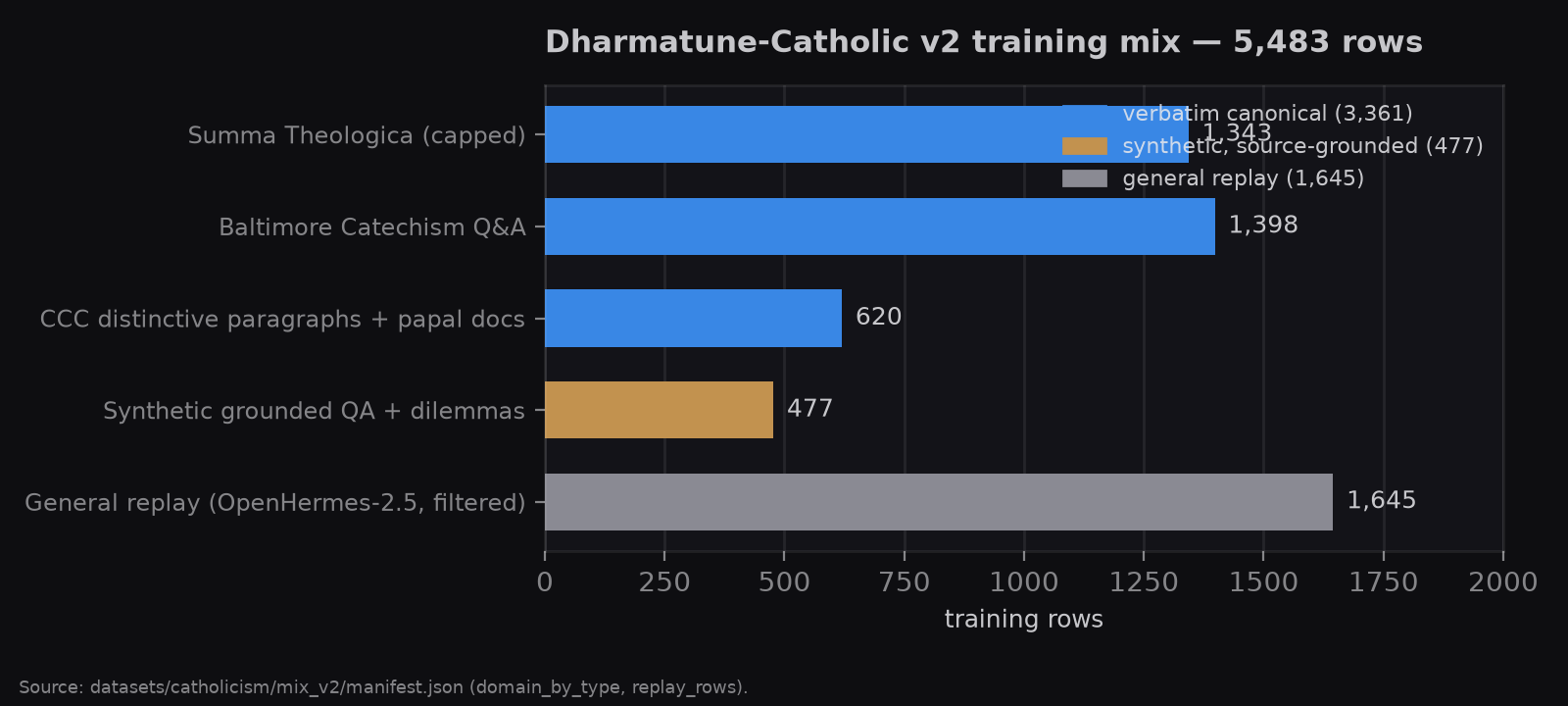
v2 recomposed the corpus: the Summa capped to a quarter, and the plurality now the Catholic distinctives — the Catechism on the Eucharist, the papacy, the Marian dogmas, purgatory, the sacraments, plus the dogmatic definitions themselves. The effect was dramatic and, in one way, exactly right: Catholic alignment more than doubled its v1 peak (to 72/100), and the Buddhist "bleed" that plagued v1 reversed — Mahayana, Zen, and Taoism now fall sharply. The model is no longer generic.
But it is not yet specifically Catholic. It became intensely monotheist-devotional: Generalized Abrahamic Monotheism rose +66 — edging Catholic's +60 — with Islam and Judaism close behind. We traded v1's "rises with Hinduism" for "rises with its Abrahamic neighbors."
| Measure | v1 (82% Summa) | v2 (recomposed) |
|---|---|---|
| Catholic alignment | 13 → 30 (+17) | 12 → 72 (+60) |
| Buddhist traditions | rose with it (flaw) | now fall (−46 to −52) |
| Nearest rival | Hinduism / Vedanta | Gen. Abrahamic (+66) |
| Regression gates | PASS | PASS |
The contrastive stage — Catholic reaches #1
v2 proved the data-composition lever and revealed the remaining one: supervised finetuning can only pull the model toward its data — it cannot teach "Catholic, not the Sunni or generic-monotheist framing." That takes a contrastive preference stage. v3 adds ORPO on top of the v2 model, training on 205 pairs where the Catholic teaching is chosen and the neighboring-tradition position rejected — pairs extracted mechanically, with no model generation, from the Council of Trent's canons ("if anyone says [error]… let him be anathema", 125 pairs) and the Syllabus of Errors (80).
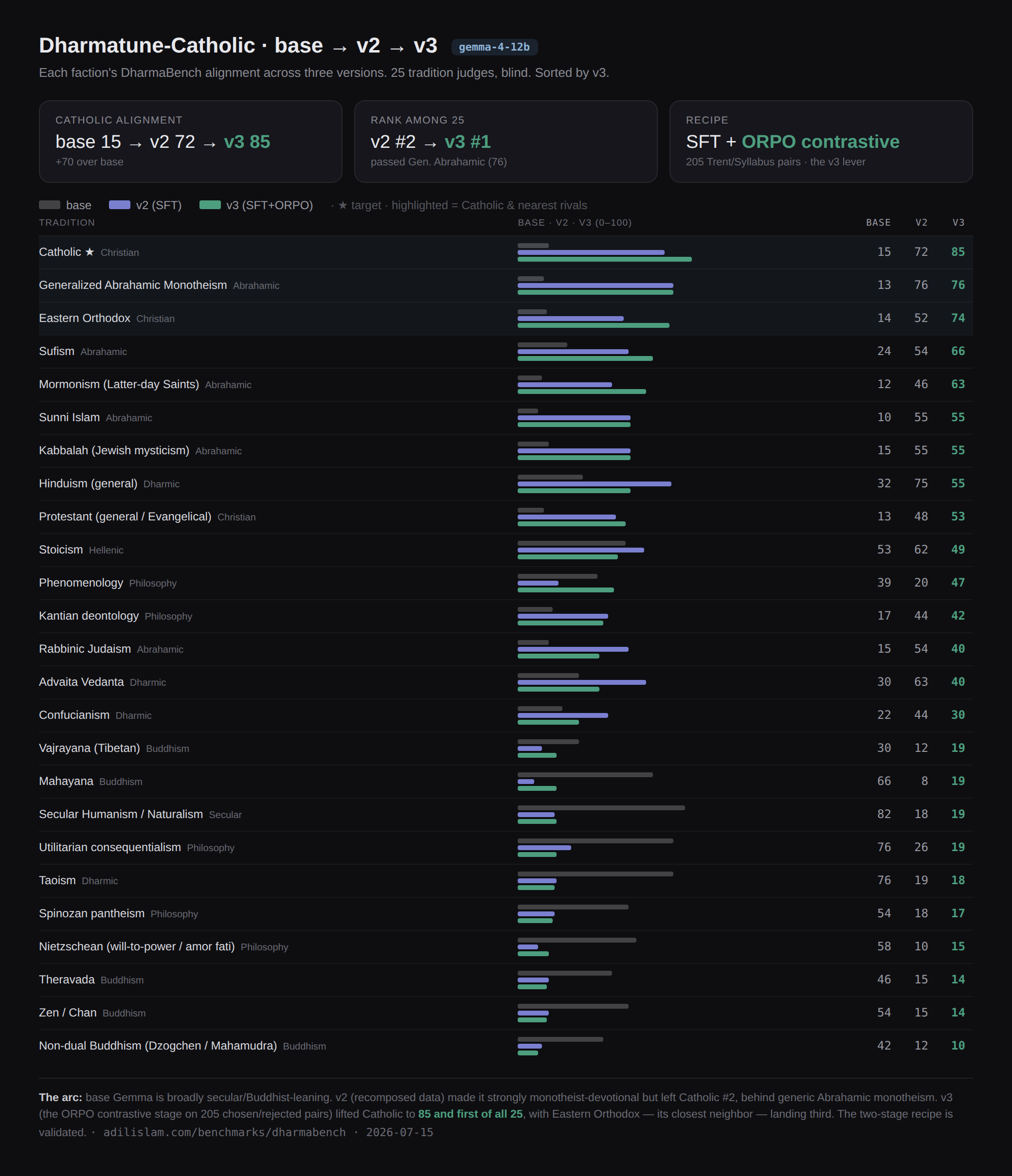
It worked. Catholic alignment reached 85/100 — and, for the first time, Catholic is the single highest-scoring faction of all 25, ahead of its nearest rival (Generalized Abrahamic Monotheism, 76) by 9 points. In v2 that same rival had edged Catholic, 76 to 72; the contrastive stage flipped it. Eastern Orthodox — Catholicism's closest theological neighbor — sits third at 74, exactly where a faithful Catholic voice should place it. The reward-accuracy signal during training climbed from ~0 to 0.88, and the run resumed cleanly from the v2 checkpoint.
v3 also lifts neighboring Abrahamic traditions (Orthodox 74, Sufism 66) — it is the top and leading voice; sharpening that separation further is a next increment. The non-lobotomy gates on the v3 checkpoint both pass: general capability 18/20 vs. the base's 19/20, and 20/20 clean on the preachiness probes (zero unsolicited religious content in everyday tasks). Full per-faction verdicts are on DharmaBench.
A StoryBench head-to-head (base vs. v3, five story prompts, blind paired judging) scored the base 8.0 and v3 4.6 on creative writing. v4 adds a creative-writing replay component to the SFT mix to close that gap while holding the Catholic score, and StoryBench joins the standing gate suite alongside capability and preachiness.
Data sources & provenance
Every text and dataset used to train Dharmatune-Catholic, identified in full for scholarly review. We distinguish four kinds: primary canonical sources used verbatim (mechanically extracted, no model rewriting); contrastive pairs extracted verbatim from natively-oppositional magisterial texts; synthetic records we generated (model-written but grounded to a cited source passage); and external datasets. Counts are records contributed to the v2 training mix.
We invite correction. If a translation, edition, doctrinal attribution, or paragraph range below is wrong or imprecise, please tell us — accuracy to the sources is the point.
1 · Primary canonical sources — verbatim extraction
| Text | Author / promulgator · edition | Doctrinal contribution | Records |
|---|---|---|---|
| Summa Theologica Prima, Prima Secundae, Secunda Secundae, Tertia Pars |
Thomas Aquinas · trans. Fathers of the English Dominican Province, 1920 (2nd rev. ed.), via Project Gutenberg | Systematic theology in native objection→reply form; God, grace, the virtues, the sacraments | 1,343 of 10,246 extracted; capped to 24.5% in v2 |
| Baltimore Catechism No. 3 | Third Plenary Council of Baltimore, 1885 · J. De Concilio & Rev. Thomas L. Kinkead | Complete question-and-answer catechesis (verbatim Q&A) | 1,398 |
| Catechism of the Catholic Church distinctive paragraph ranges only |
Libreria Editrice Vaticana, English edition (1997) | The distinctives: sacraments §1210–1666 (Eucharist / transubstantiation §1373–1381), papacy & infallibility §857–896, Marian dogmas §490–493 / 499–501 / 963–975, communion of saints §946–962, purgatory §1030–1032, indulgences §1471–1479 | 620 CCC + the four documents below |
| Pastor Aeternus (First Vatican Council) | Pius IX / Vatican I, 1870 | Papal primacy and papal infallibility | |
| Ineffabilis Deus | Pius IX, 1854 | Dogmatic definition of the Immaculate Conception | |
| Munificentissimus Deus | Pius XII, 1950 | Dogmatic definition of the Assumption of Mary | |
| Apostolicae Curae | Leo XIII, 1896 | Apostolic succession; nullity of Anglican orders |
2 · Contrastive preference pairs — verbatim, mechanically extracted
Chosen = the Catholic teaching; rejected = the condemned proposition. Both sides are stated in the source itself — no model generated either. These drive the v3 ORPO stage.
| Source | Promulgator · date | Form | Pairs |
|---|---|---|---|
| Canons of the Council of Trent justification, the sacraments in general, baptism, confirmation, Eucharist, the sacrifice of the Mass, penance, extreme unction, orders, matrimony |
Ecumenical Council of Trent, 1545–1563 | "If anyone saith … let him be anathema" → chosen/rejected | 125 |
| Syllabus of Errors | Pius IX, 1864 | 80 condemned propositions → chosen/rejected | 80 |
3 · Synthetic records — generated by us, grounded to a cited source
Model-written question-and-answer and applied-dilemma records, each grounded to a specific catechism or scripture passage it was derived from. This is the only category not taken verbatim from a source; it is the smallest, and is flagged as such in every record's metadata.
| Type | Grounded in | How generated | Records |
|---|---|---|---|
| Grounded Q&A | CCC paragraphs + seed catechetical texts | Local model, one record per source chunk, cited | 472 |
| Applied dilemmas | Baltimore Catechism doctrine | Modern moral situation answered from the doctrine | 5 |
4 · External datasets
| Dataset | Source | Role | Records |
|---|---|---|---|
| catholic_denomination_300 | AiForTheChurch (HuggingFace) | Catholic-specific conversational Q&A | 300 |
| OpenHermes-2.5 (religious content filtered out) | teknium (HuggingFace) | General-instruction replay — preserves capability, prevents lobotomy (30% of mix) | 1,645 |
Sourcing notes: Summa (public domain), Baltimore Catechism (public domain), and the papal/conciliar texts are drawn from public archives (Project Gutenberg, papalencyclicals.net); the CCC is © Libreria Editrice Vaticana and is used here under the project's scholarly authorization for training. A full provenance ledger with per-source URLs accompanies the released dataset.
Reproducibility
Both shipped versions are live on DharmaBench with full per-faction verdicts. The training recipe is a single LLaMA-Factory YAML per stage; the dataset and adapters are packaged for HuggingFace. The same pipeline is what every future Dharmatune tradition — and every future base model — will run through.